Light Through Glass: The Loss Equations That Matter
Light is strange. It behaves like a wave when it diffracts around obstacles and interferes with itself. It behaves like a particle when it knocks electrons off metal surfaces. Neither description is complete on its own. Both are true, depending on how you look.
This duality is not just a physics curiosity. It sits underneath everything that happens inside a fiber — why the glass guides light at all, why energy is lost along the way, and how we measure what's left at the other end.
Energy Comes in Packets
Max Planck figured out in 1900 that light doesn't carry energy continuously — it carries it in discrete chunks. Each chunk, a photon, has energy tied directly to its frequency:
E = hfwhere h is Planck's constant (6.626 × 10⁻³⁴ J·s) and f is the frequency of the light. Since frequency and wavelength are related by the speed of light (f = c / λ), this becomes:
E = hc / λWhat this means in practice: a photon at 1550 nm carries less energy than one at 1310 nm. The longer the wavelength, the lower the energy per photon. This matters because lower-energy photons interact less aggressively with the glass — they scatter less, absorb less, and travel farther before the signal fades. That's the physics reason 1550 nm is the long-haul wavelength.
The Wave Side: How Glass Guides Light
Fiber works because of total internal reflection — a wave optics phenomenon. The core glass has a slightly higher refractive index than the cladding around it. When the wave hits that boundary at a shallow enough angle, it doesn't pass through. It reflects back into the core and keeps going.
The condition for this is the critical angle. Below it, light escapes. Above it, the fiber guides it.
What matters for the field is numerical aperture — the cone of angles over which the fiber accepts light:
NA = √(n₁² − n₂²)For standard single-mode fiber, NA is around 0.11. That's a narrow cone. It's why launch alignment matters, why a dirty connector face matters, and why you can't slap two mismatched fibers together without a penalty.
How Loss Works: Beer-Lambert in Glass
Once light is inside the fiber, it attenuates. The mechanism is well-described by Beer-Lambert: power decays exponentially with distance.
P(L) = P₀ · e^(−αL)P₀ is the launched power, L is the length, and α is the attenuation coefficient of the glass — a material property that depends heavily on wavelength. In fiber work we almost always express this in decibels per kilometer, which converts the exponential to something you can add up:
Loss (dB) = α · LAt 1310 nm, α is roughly 0.34 dB/km for standard G.652 single-mode fiber. At 1550 nm it drops to around 0.19 dB/km. The reason for the difference comes back to the particle side: shorter wavelengths mean higher-energy photons, which scatter more readily off the microscopic density fluctuations in the glass. This is Rayleigh scattering, and it scales as 1/λ⁴ — the same physics that makes the sky blue.
The Decibel Is Just a Ratio
Everything in a fiber link is measured in decibels because loss compounds multiplicatively, and logs turn multiplication into addition.
Loss (dB) = 10 · log₁₀(P_in / P_out)Three decibels is half your power. Ten decibels is one tenth. These are the two numbers worth internalizing — the rest follows from them. A transmitter putting out +3 dBm into a receiver that needs –28 dBm gives you 31 dB of budget. Every splice, connector, and meter of glass takes a cut of that.
Putting It Together: The Link Budget
A link budget is nothing more than Beer-Lambert applied to a whole system. You add up every loss contributor and check that the total stays inside the budget.
Margin = P_tx − P_rx_min − (α · L) − (splices · loss_per_splice) − (connectors · loss_per_connector) − otherA healthy margin is at least 3 dB. I like to see 5 or more on anything I sign off on — that's the buffer against aging connectors, a future repair splice, and the cable that got bent a little too tight somewhere in the conduit.
The Planck equation quietly underpins the whole thing. Lower photon energy at 1550 nm means lower α, which means more budget available before you hit the receiver threshold. The choice of wavelength isn't arbitrary — it's a direct consequence of how light interacts with matter at the quantum level.
What the OTDR Is Actually Measuring
An OTDR sends a pulse of light down the fiber and listens for what comes back. The backscatter it captures is the wave behaving as a wave — small amounts of light continuously scattering back toward the source as the pulse propagates forward.
The trace is a plot of that backscattered power versus distance. Its slope is α. A splice shows as a step down. A connector shows as a step down with a reflection spike. The math is just Beer-Lambert read backward.
When a splice looks like a gainer on the trace — an upward step instead of a step down — that's not real. It's an artifact of the backscatter coefficient being slightly different on each side of the joint. Measure from both ends and average. The true loss lives in the average.
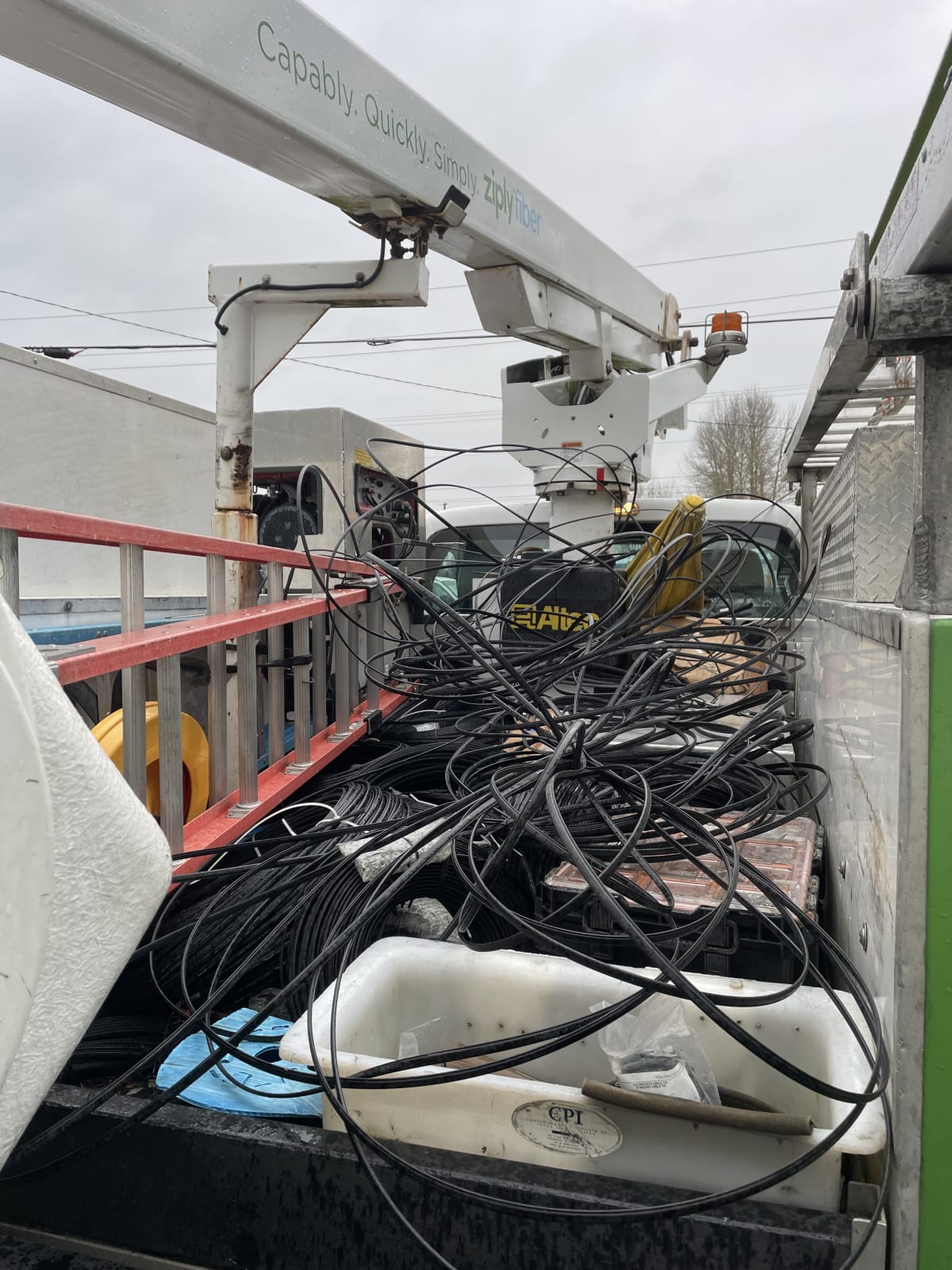
Every equation here follows from two ideas: light carries energy in quanta (Planck), and that energy attenuates exponentially through matter (Beer-Lambert). The rest is geometry and unit conversions. The physics is simple. The craft is in applying it reliably, in a bucket truck, in the rain, on a fiber that someone needs back online.